
Welcome to PhysicsMonk.com – the most trusted Physics doubt solving platform for IIT-JEE, NEET, and CBSE students.

Vivek Singh
HOD Physics @ Unacademy Bhilai
Former Director — Vibrant Academy | Former Faculty — Aakash Institute
In his free time, he provides career counseling on Dial Me 24/7
Hi, this is Vivek Singh. I help NEET and IIT-JEE aspirants do the one thing that matters most: get selected.
If your focus keeps slipping, your marks aren’t moving, or you’re studying hard with zero results—I’ll tell you exactly what’s breaking your preparation and how to fix it fast.
My priority is simple: Turn your preparation into a selection.
From routine, discipline and strategy to exam temperament—I break down everything toppers get right and average students miss.
Once the rank comes, I guide you on which branch to pick, which college to trust, and how to lock a path that gives long-term success.
If things don’t go as planned, I help you make smart next moves without wasting a year or losing confidence.
If you want sharp guidance, honest feedback, and a push that converts effort into results — I’m here for you.
Get Clear Physics Solutions — Fast
Stuck in Physics? Confused between DC Pandey, SL Arora or NCERT?
PhysicsMonk gives fast, accurate doubt-solutions for
IIT-JEE & NEET Physics — no YouTube overload, no confusion.
Browse solutions by chapter, book or exam level.

NEET2011:A body is moving with velocity 30 m/s towards east. After 10 seconds its velocity becomes
July 5, 2025
Description A body is moving with velocity 30 m/s towards east. After 10 seconds its velocity becomes 40 m/s towards north. The average acceleration of the body is A . 1 m/s 2 B . 7 m/s 2. C . √ 7 m/s 2. D . 5 m/s 2 Frequently Asked Questions How to prepare

NEET 2011:A missile is fired for maximum range with an initial velocity of 20 m/s. Ifg = 10ms2, the
July 5, 2025
Description A missile is fired for maximum range with an initial velocity of 20 m/s. If g = 10ms2, the range of missile is A. 40 m. B. 50 m. C. 60 m D. 20 m Frequently Asked Questions How to prepare for NEET Physics? For NEET Physics preparation, focus on NCERT textbooks first, then
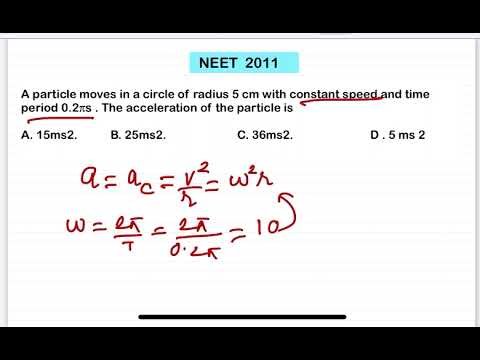
NEET 2011 A particle moves in a circle of radius 5 cm with constant speed and time period 0.2πs
July 5, 2025
Description A particle moves in a circle of radius 5 cm with constant speed and time period 0.2πs . The acceleration of the particle is A. 15ms2. B. 25ms2. C. 36ms2. D . 5 ms 2 Frequently Asked Questions How to prepare for NEET Physics? For NEET Physics preparation, focus on NCERT textbooks first, then
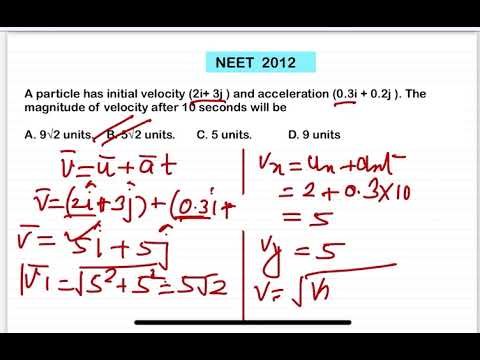
NEET 2013: A particle has initial velocity (2i+ 3j ) and acceleration (0.3i + 0.2j ). The magnitude
July 5, 2025
Description A particle has initial velocity (2i+ 3j ) and acceleration (0.3i + 0.2j ). The magnitude of velocity after 10 seconds will be A. 9√2 units. B. 5√2 units. C. 5 units. D. 9 units Frequently Asked Questions How to prepare for NEET Physics? For NEET Physics preparation, focus on NCERT textbooks first, then
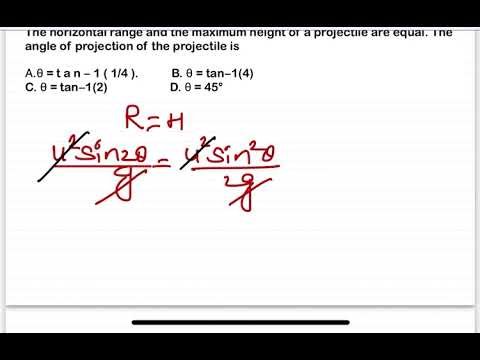
NEET2013:The horizontal range and the maximum height of a projectile are equal. The angle of
July 5, 2025
Description The horizontal range and the maximum height of a projectile are equal. The angle of projection of the projectile is A.θ = t a n − 1 ( 1/4 ). B. θ = tan−1(4) C. θ = tan−1(2) D. θ = 45° Frequently Asked Questions How to prepare for NEET Physics? For NEET Physics

NEET2013:Vectors, A, B and C are such that A ⋅B = 0 and A ⋅C = 0. Then the vectorparallel to A is A
July 5, 2025
Description Vectors, A, B and C are such that A ⋅B = 0 and A ⋅C = 0. Then the vector parallel to A is A . A × B B . B + C C . B × C D . B and C Frequently Asked Questions How to prepare for NEET Physics? For
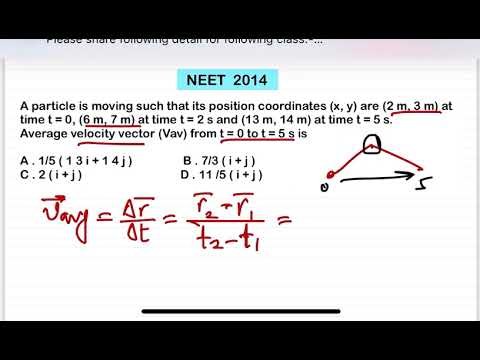
NEET 2014: A particle is moving such that its position coordinates (x, y) are (2 m, 3 m) at time t =
July 5, 2025
Description A particle is moving such that its position coordinates (x, y) are (2 m, 3 m) at time t = 0, (6 m, 7 m) at time t = 2 s and (13 m, 14 m) at time t = 5 s. Average velocity vector (Vav) from t = 0 to t = 5

A projectile is fired from the surface of the earth with a velocity of 5ms−1 and angle θ
July 5, 2025
Description A projectile is fired from the surface of the earth with a velocity of 5ms−1 and angle θ with horizontal. Another projectile fired from another planet with a velocity of 3ms−1 at the same angle follows a trajectory which is identical with the trajectory of the projectile fired from the earth. The value of
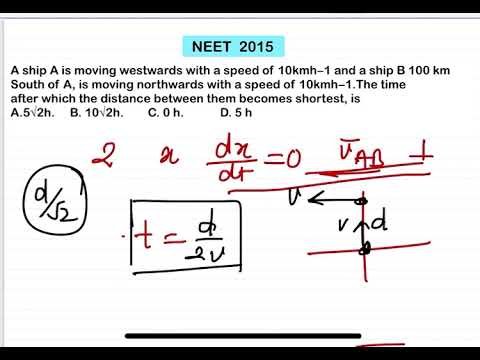
NEET 2015 :A ship A is moving westwards with a speed of 10kmh−1 and a ship B 100 km South of A,
July 5, 2025
Description Shortest distance in 2D theory video + solution2 by basic methods A ship A is moving westwards with a speed of 10kmh−1 and a ship B 100 km South of A, is moving northwards with a speed of 10kmh−1.The time after which the distance between them becomes shortest, is A.5√2h. B. 10√2h. C. 0

NEET 2015:The position vector of a particle →R as a function of time is given by R = 4 sin(2πt) i
July 5, 2025
Description The position vector of a particle →R as a function of time is given by R = 4 sin(2πt) i + 4 cos(2πt) j Where R is in meters,t is in seconds and i and j denote unit vectors along x − and y − directions , respectively. Which one of the following statements
“PhysicsMonk” by Mr. Vivek Singh Sir & team